21CEE / ANALYSIS
The 2028 conversation has accelerated. Early polls still test possibilities.
Dated hypothetical matchups show how voters respond to selected names. They do not establish nominees, candidacies or election odds.
By 21CEE Editorial Analysis • Prepared November 4, 2026 • AI-assisted
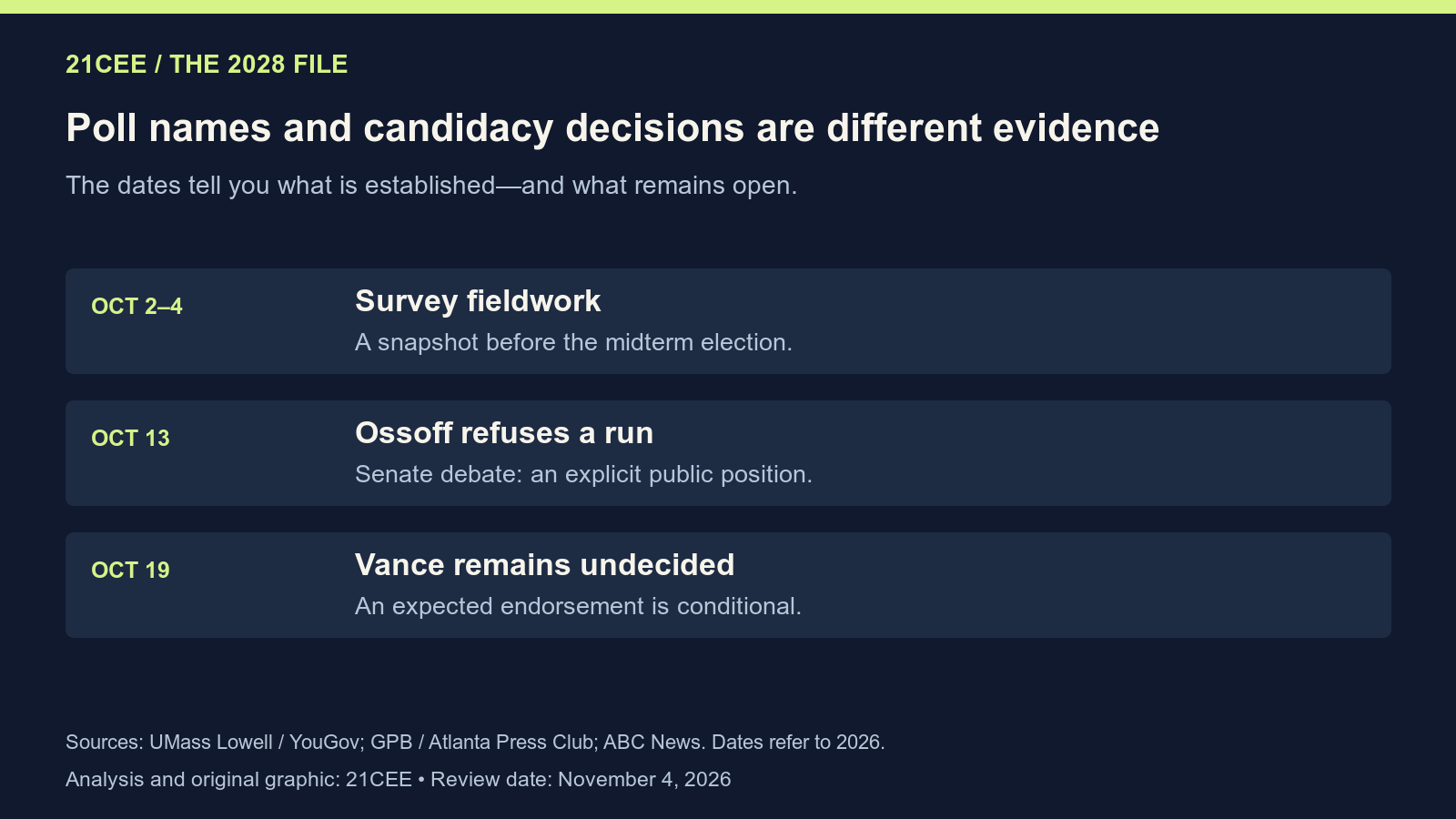
Attention has already turned from the midterms to 2028, but the names being discussed have not made the same decisions. Jon Ossoff said no in his October Senate debate. JD Vance left the question open in October, and the Associated Press’s November 4 report still described his choice as pending. [GPB / Atlanta Press Club, carried by BTPM PBS] [ABC News] [Associated Press, carried by Boston.com]
That distinction changes how an early ballot test should be read. A pollster can put a name in a question even if that person has not chosen to run. The answer records a reaction to the proposed choice at the time of the interview. It cannot settle who will enter a primary, who a party will nominate, or which combination of candidates voters will actually face. Those are separate questions. [UMass Lowell Center for Public Opinion / YouGov] [GPB / Atlanta Press Club, carried by BTPM PBS] [ABC News]
Four hypothetical October ballot tests
Percent of the full likely-voter sample in each separate question. Fieldwork October 2–4, 2026. Published October 22. Rounded totals may differ from 100; no two-party normalization.| Hypothetical pairing | Democrat (%) | Republican (%) | Another candidate (%) | Undecided (%) | Would not vote (%) |
|---|
| Newsom vs. Vance | 46 | 42 | 4 | 6 | 2 |
| Ocasio-Cortez vs. Vance | 45 | 42 | 3 | 7 | 3 |
| Newsom vs. Rubio | 44 | 42 | 3 | 9 | 1 |
| Ocasio-Cortez vs. Rubio | 43 | 43 | 3 | 9 | 2 |
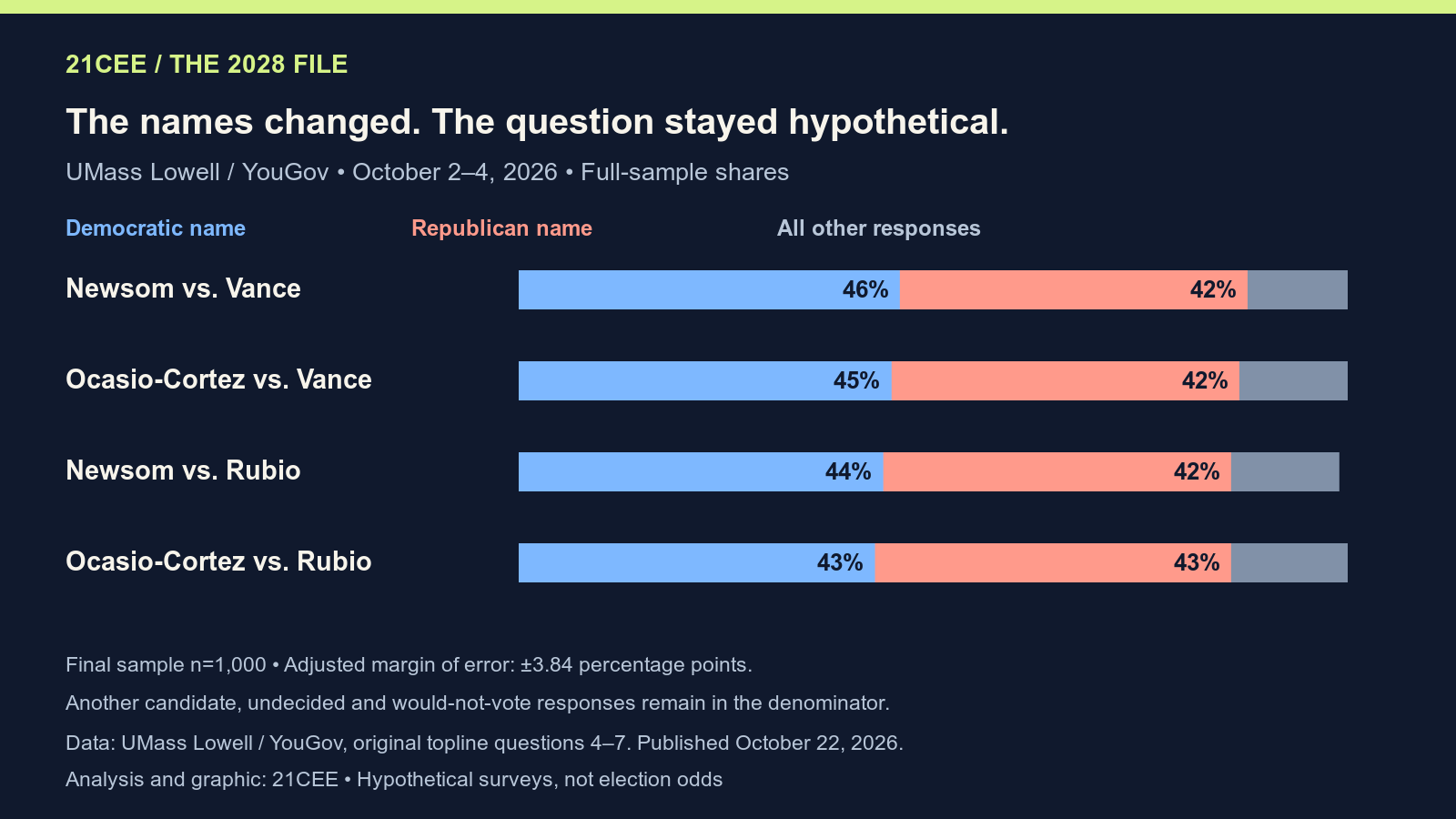
The October UMass Lowell/YouGov survey asked four such questions involving Newsom or Ocasio-Cortez against Vance or Rubio. Its fieldwork preceded the midterms. These results are therefore useful as a dated reference for the discussion now beginning, rather than a measurement of how the election changed presidential preferences. [UMass Lowell Center for Public Opinion / YouGov] [UMass Lowell]
The full response distribution matters. Some respondents chose another candidate, remained undecided, or said they would not vote. Removing those answers and rescaling only the two named politicians would answer a different question. The accompanying figures retain the original shares and show the remaining answers separately. Small differences in published percentages also should not be treated as precise rankings of political talent. [UMass Lowell Center for Public Opinion / YouGov]
The survey’s final sample comprised 1,000 likely voters from October 2–4 and reports an adjusted margin of error of 3.84 percentage points. That is the stated uncertainty for a survey estimate, not a candidate’s probability of winning. The uncertainty around a difference between candidates requires its own calculation; this article does not label any pairing a statistically significant lead. [UMass Lowell Center for Public Opinion / YouGov]
A useful next update would bring genuinely new evidence: an explicit candidacy decision, a new comparable poll with its field dates and response options, or a clear change in a politician’s stated position. Repeating a familiar name more often is not the same as obtaining any of those. Until then, the disciplined reading is narrower: these are possibilities voters have been asked to consider, with the dates and limits still attached. [UMass Lowell Center for Public Opinion / YouGov] [GPB / Atlanta Press Club, carried by BTPM PBS] [ABC News]
Source record
Original analysis and graphics: 21CEE. Polls retain their original field dates.Vance’s conditional position
Ossoff’s explicit refusal