21CEE / ANALYSIS
Ossoff’s 2028 speculation meets an explicit public refusal.
His October 13 debate pledge is newer than the summer denials. An August hypothetical poll explains interest in his name, while leaving his decision unchanged.
By 21CEE Editorial Analysis • Prepared November 4, 2026 • AI-assisted
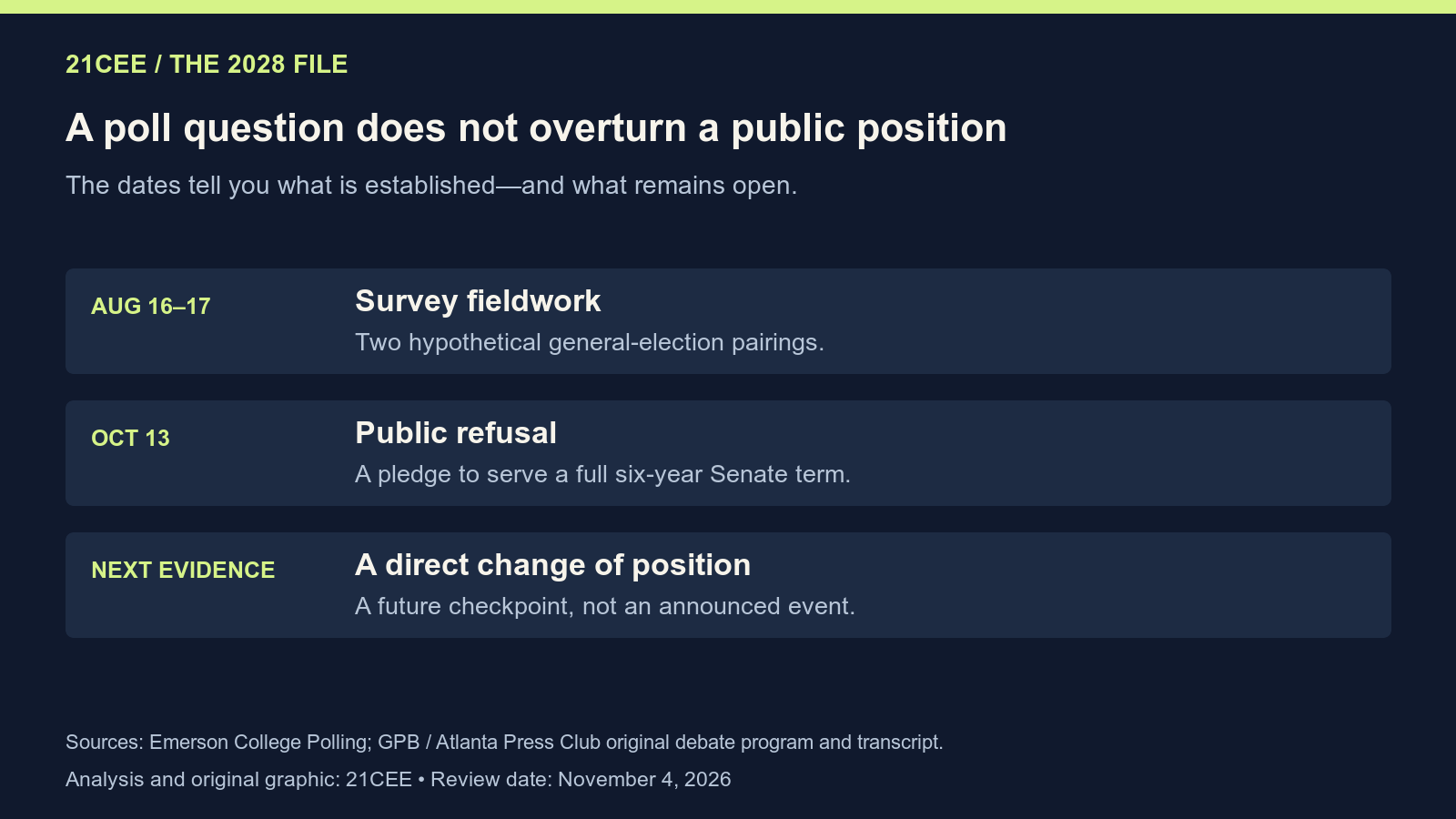
Jon Ossoff appears in presidential polls, but he has told voters he does not want to run. At the October 13 Atlanta Press Club Senate debate, he promised to serve a full six-year term if reelected and again rejected a presidential bid. That statement is newer than the summer interviews often cited in the 2028 discussion. [GPB / Atlanta Press Club, carried by BTPM PBS]
The original GPB program, available with a transcript through PBS, records the moderator asking for that commitment. Ossoff replied that he would serve the term and said he had “zero interest in running for president.” This analysis found no newer reversal in the reviewed sources as of November 4. It treats the refusal as his stated position rather than assuming that speculation reveals a hidden campaign. [GPB / Atlanta Press Club, carried by BTPM PBS]
A dated poll helps explain why readers ask about him. Emerson College Polling included Ossoff in two hypothetical presidential questions in August. Those are tests of a proposed ballot, not evidence that he authorized a campaign or accepted a place in the field. [Emerson College Polling] [Emerson College Polling]
Ossoff in the August national hypothetical ballot tests
Percent of the original full likely-voter sample. Fieldwork August 16–17, 2026; published August 20. Exact reported percentages are shown; rounding may produce totals other than 100.| Hypothetical pairing | Ossoff (%) | Republican (%) | Undecided (%) |
|---|
| Ossoff vs. Vance | 48.8 | 43.8 | 7.4 |
| Ossoff vs. Rubio | 47.4 | 44.1 | 8.6 |
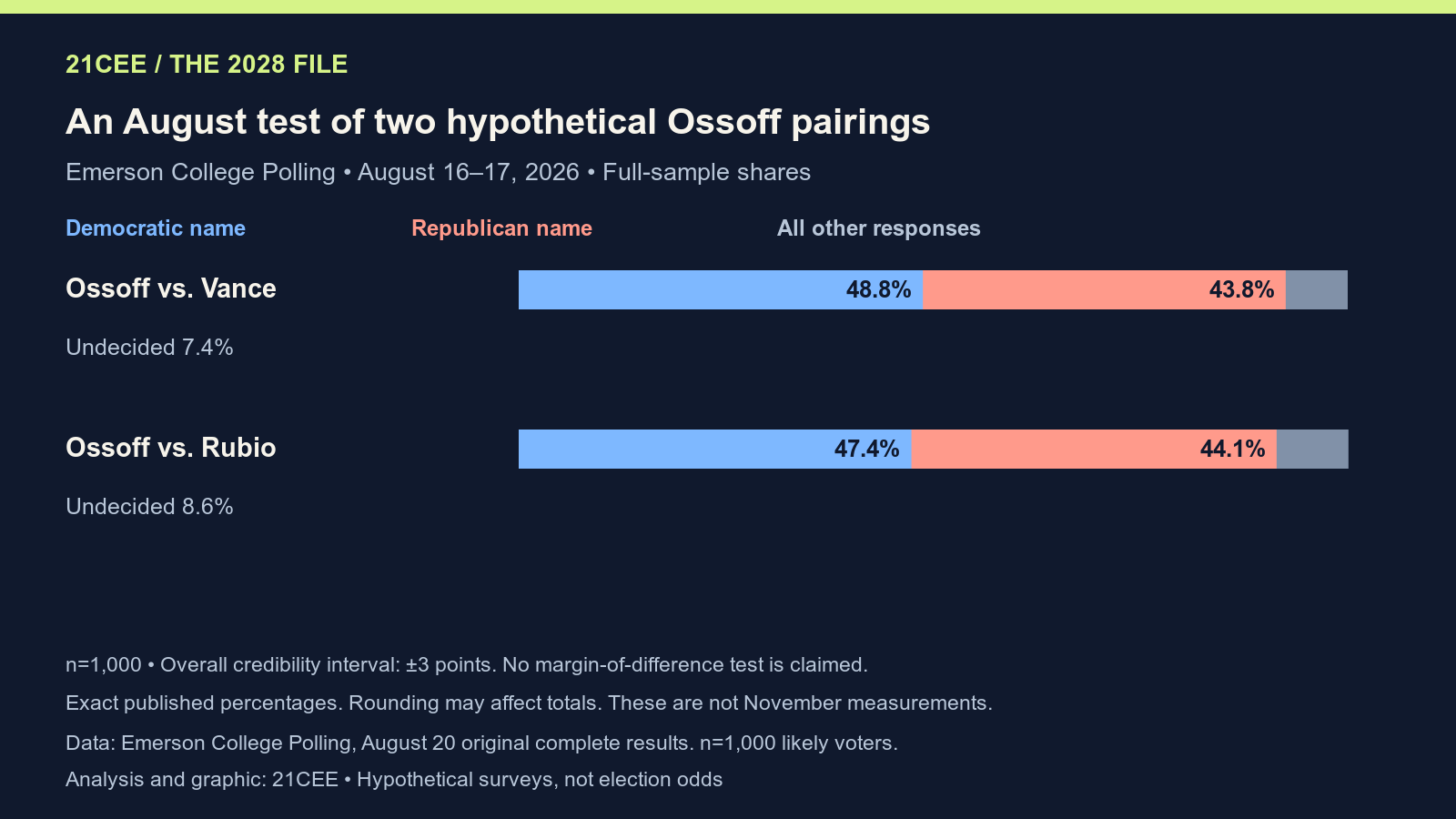
The original table reports 48.8% for Ossoff, 43.8% for Vance and 7.4% undecided in one pairing. Against Rubio, it reports 47.4%, 44.1% and 8.6%. Those are different questions asked in the same survey; the differences between them are not evidence that voters moved from one politician to another. [Emerson College Polling]
Emerson interviewed 1,000 likely voters on August 16–17 and gives an overall credibility interval of plus or minus three points. The interviews preceded both Ossoff’s October debate statement and the midterms. The data therefore cannot quantify a post-election surge, and a poll share should not be read as his probability of becoming president. This article makes no significance claim about the matchup margins. [Emerson College Polling]
The public evidence supports a narrower kind of possibility discussion. A poll can show that a proposed pairing was worth examining; an explicit refusal tells us what the person says he intends to do. Both can be true at once. Treating the first as proof that the second is insincere would add a claim about private motives that these sources do not establish. [Emerson College Polling] [GPB / Atlanta Press Club, carried by BTPM PBS]
For a future update, the decisive development would be a direct change in Ossoff’s position, followed by comparable new polling and the ordinary evidence of a campaign. Without that, his name belongs in a discussion of hypothetical alternatives accompanied by his refusal. The calendar should remain visible: an August survey and an October statement are evidence from those dates, not a newly measured November presidential race. [GPB / Atlanta Press Club, carried by BTPM PBS] [Emerson College Polling]
Source record
Original analysis and graphics: 21CEE. Polls retain their original field dates.