21CEE / ANALYSIS
Vance’s 2028 possibilities start with a decision he has not announced.
His October endorsement prediction was conditional. A later Trump response and dated ballot tests show why succession is still a question.
By 21CEE Editorial Analysis • Prepared November 4, 2026 • AI-assisted
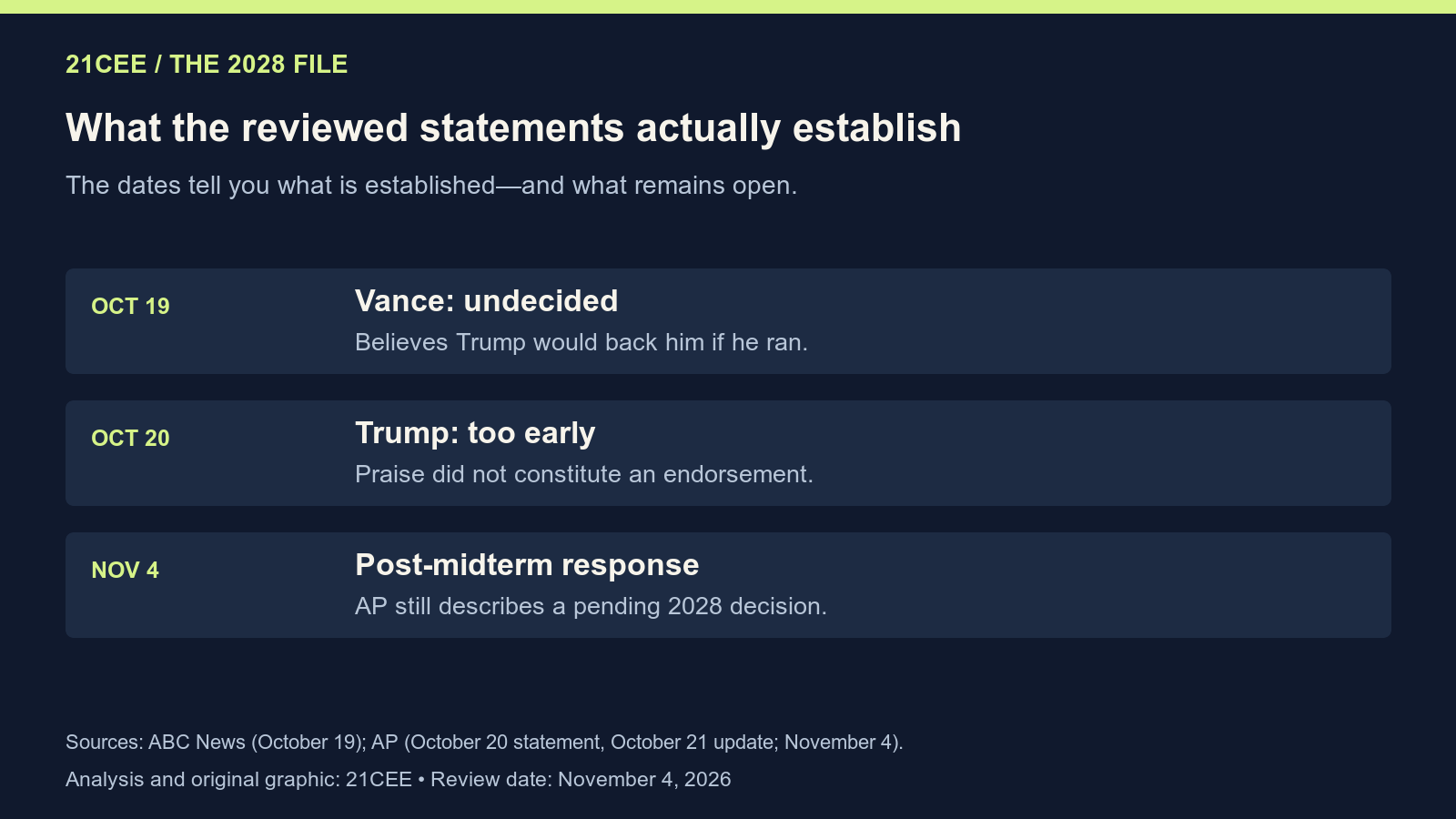
JD Vance has left his 2028 decision open. In the October 19 interview reported by ABC News, the vice president said he had not decided whether to run. He thought Donald Trump would endorse him if he did, but had not discussed that with the president. It was a prediction about a possible endorsement, not an endorsement announcement. [ABC News]
Trump’s subsequent answer reinforces the distinction. Speaking with reporters on October 20, he praised Vance but said it was early to discuss a successor and that they had not talked about it, according to the Associated Press. The AP’s November 4 account of Vance’s response to the midterm results still described him as facing questions about his political future. This review found no newer candidacy announcement in those sources. [Associated Press, carried by ClickOnDetroit] [Associated Press, carried by Boston.com]
For readers assessing his possibilities, three decisions remain separate: entering the race, winning the Republican nomination, and winning a general election. An endorsement could affect the first contest among Republicans; it does not answer the general-election question. Nor does Vance’s belief about a future endorsement substitute for a statement from Trump granting it. [ABC News] [Associated Press, carried by ClickOnDetroit]
Vance in two October hypothetical pairings
Original full-sample percentages; October 2–4 fieldwork. These are general-election questions, not a Republican primary poll.| Democratic name tested | Democrat (%) | Vance (%) | Another candidate (%) | Undecided (%) | Would not vote (%) |
|---|
| Gavin Newsom | 46 | 42 | 4 | 6 | 2 |
| Alexandria Ocasio-Cortez | 45 | 42 | 3 | 7 | 3 |
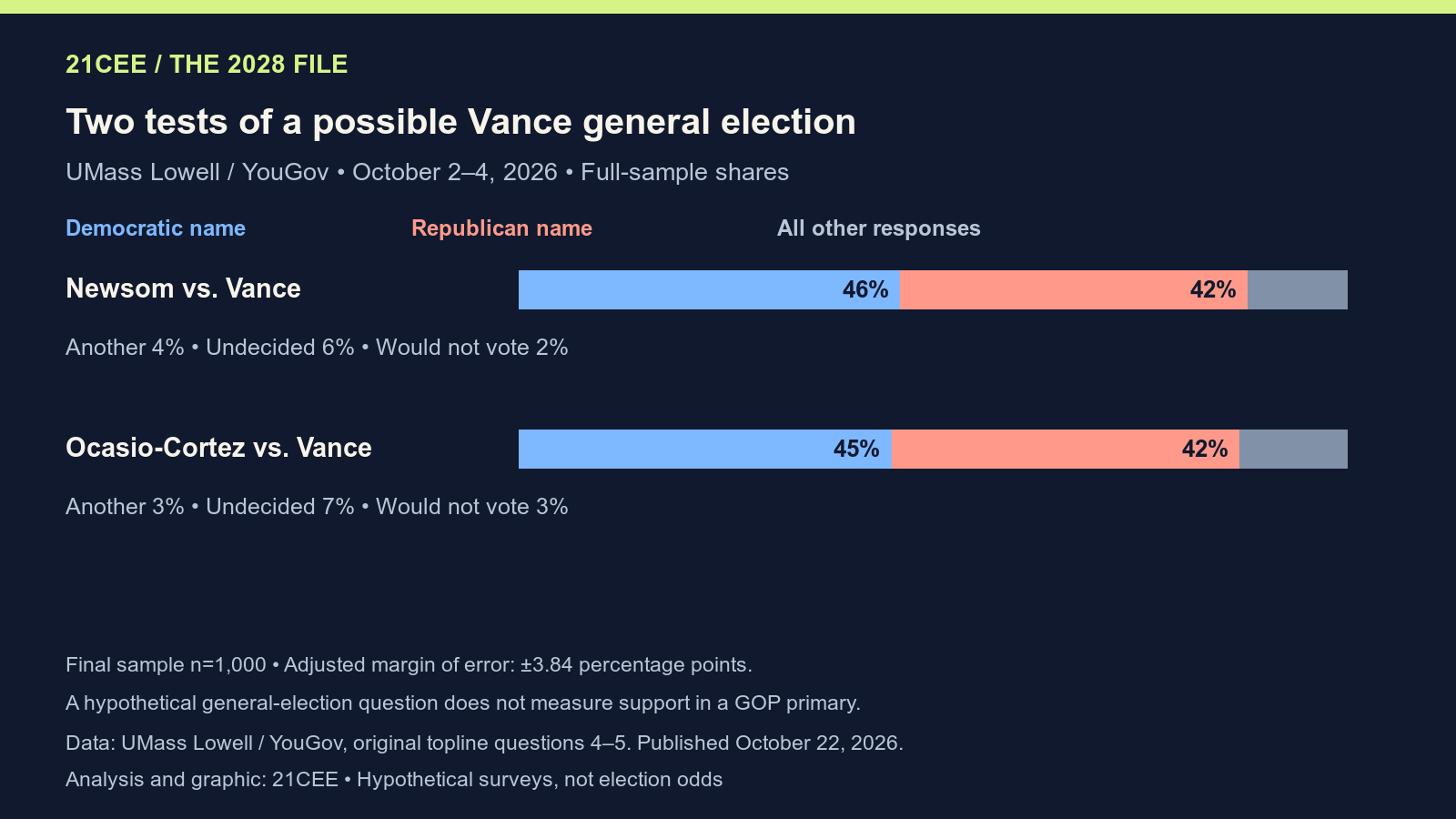
The October tests illustrate why those stages should be kept apart. UMass Lowell/YouGov asked respondents to choose between Vance and two specified Democratic alternatives. The results describe the selected matchups at that earlier moment. They cannot tell us how Vance would perform against every possible opponent, or whether Republican primary voters would choose him. [UMass Lowell Center for Public Opinion / YouGov]
Neither test absorbed the midterm outcome: interviews took place October 2–4. The survey’s likely-voter sample and its adjusted 3.84-point margin of error also need to travel with any graphic. Remaining responses are included in the denominator; they are not silently allocated to either named politician. This article makes no statistical-significance claim about the candidate differences. [UMass Lowell Center for Public Opinion / YouGov]
Vance’s November 4 response to the election supplied a political argument, not a launch announcement. The AP reported that he blamed the Iran war for Republican losses. His account of why people voted is his interpretation; it does not establish causation, and this article does not turn it into a fresh presidential poll. [Associated Press, carried by Boston.com]
The next meaningful evidence would be a direct decision about running and a current record of endorsements, followed by polling that identifies the actual question and electorate. Until that evidence arrives, “possible contender” is a more precise description than treating the vice presidency as an automatic nomination. The nomination and the presidency remain decisions for different electorates at different stages. [ABC News] [Associated Press, carried by ClickOnDetroit] [UMass Lowell Center for Public Opinion / YouGov]
Source record
Original analysis and graphics: 21CEE. Polls retain their original field dates.