2026 ELECTION · POLL AND OUTCOME REVIEW
North Carolina: ECU’s Cooper lead matched the projected winner
ECU’s late poll put Roy Cooper nine points ahead. NBC projects Cooper as the winner; an exact final-margin accuracy verdict awaits completed returns.
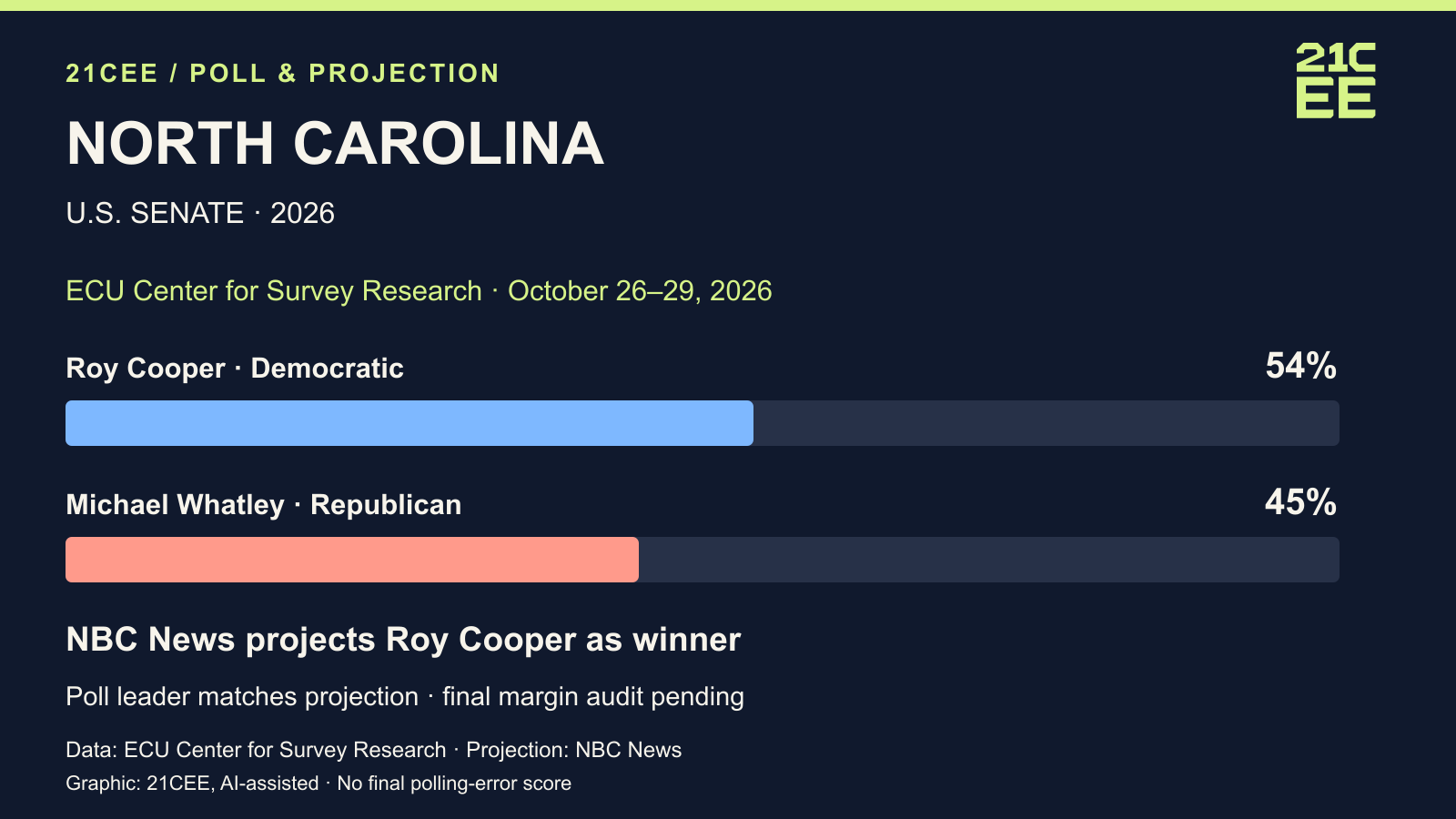
The comparison we can make
ECU’s late North Carolina Senate poll had Democratic Roy Cooper at 54%, Republican Michael Whatley at 45%, and another 1% choosing a minor-party candidate or write-in. The poll ran October 26–29. Cooper is also NBC’s projected winner. We still need completed returns before judging how close the poll’s 9-point margin comes to the result.
What ECU actually measured
The ECU Center for Survey Research released the poll November 1. It covered 1,041 registered voters who had already voted or said they were likely to vote. ECU combined text-to-web responses, landline interactive voice response and an online panel, with weighting described in its release. It reported a ±3.5-point credibility interval. The displayed nine-point lead comes from subtracting the rounded candidate shares, 54 minus 45. The release is an original pre-election record, so it can be compared with the subsequent projection without reconstructing the poll from an aggregator.
The count is a separate record
A retained NBC race-page snapshot retrieved November 4 at 4:11:56 PM Eastern contains 2,467,963 votes for Cooper and 1,643,088 for Whatley, within 4,203,181 reported votes. That is a 19.63-point reported lead when the whole reported-vote denominator is used. NBC estimates 99% of expected votes counted. The retained race summary does not supply an original count-update clock, so the retrieval time is the time this page was captured, not a claim about when the ballots were tabulated. These figures remain a dated page snapshot.
Why the margin verdict remains open
The reported margin is larger than the poll’s nine-point lead, but it would be premature to label that difference the final polling error. A network projection answers who is expected to win; it does not certify that every vote has been included. A final margin audit must use a stable final or certified result, consistent candidate identities, and a stated rule for comparing all-candidate or two-candidate shares. It should also distinguish a survey’s rounded topline from an unrounded estimate.
What this first check establishes
ECU’s leader and NBC’s projected winner agree. That is a useful first result, while the size of the eventual gap remains a different question. The graphics preserve both denominators: poll support among the survey’s voter population and the reported-vote shares in the retained NBC page. Neither tells us why any difference occurred. Late preference changes, turnout composition, measurement choices and remaining ballots require additional evidence; this comparison alone cannot isolate their effects.
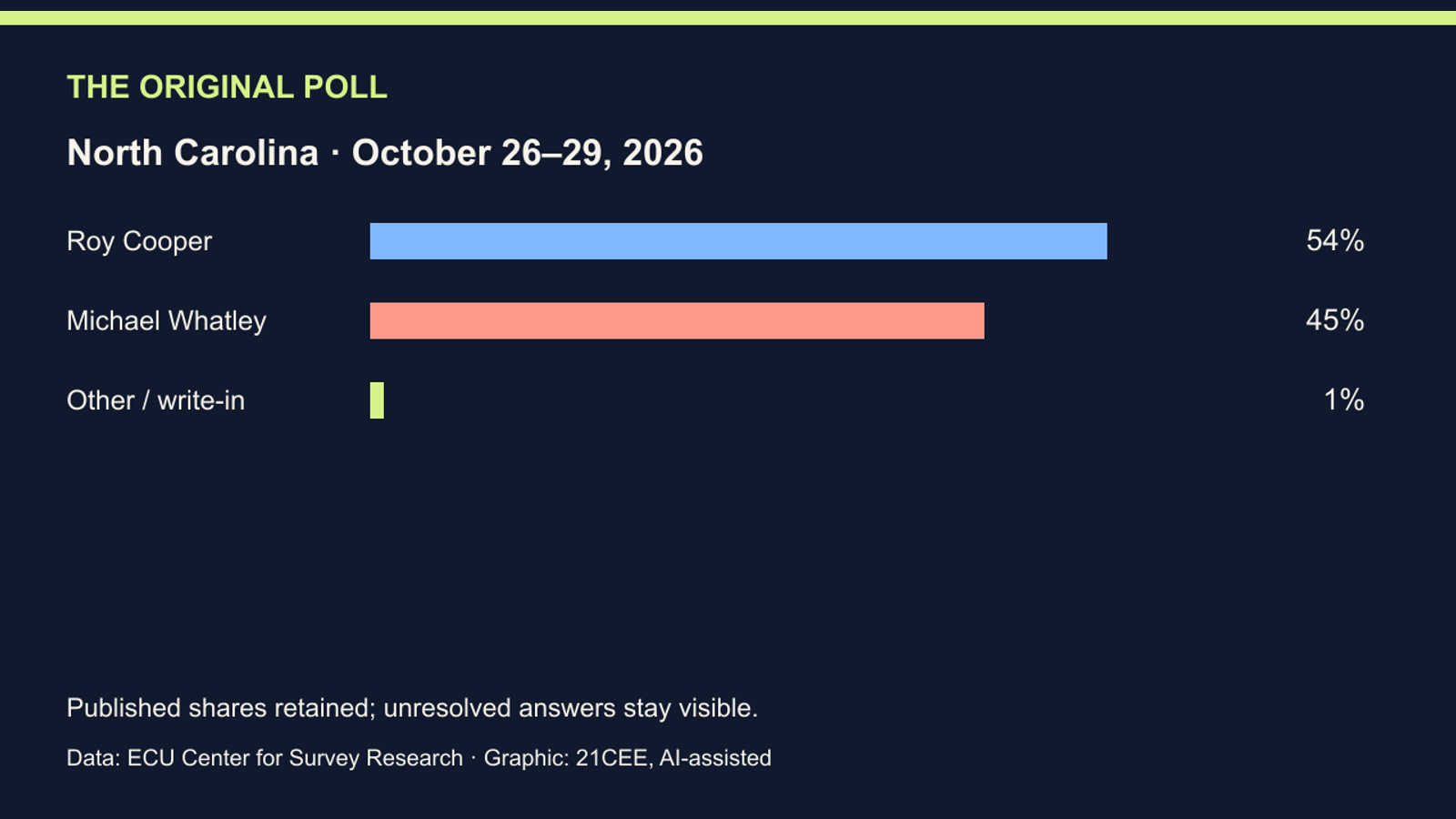
| Candidate or response | Poll share |
|---|---|
| Roy Cooper | 54% |
| Michael Whatley | 45% |
| Other / write-in | 1% |
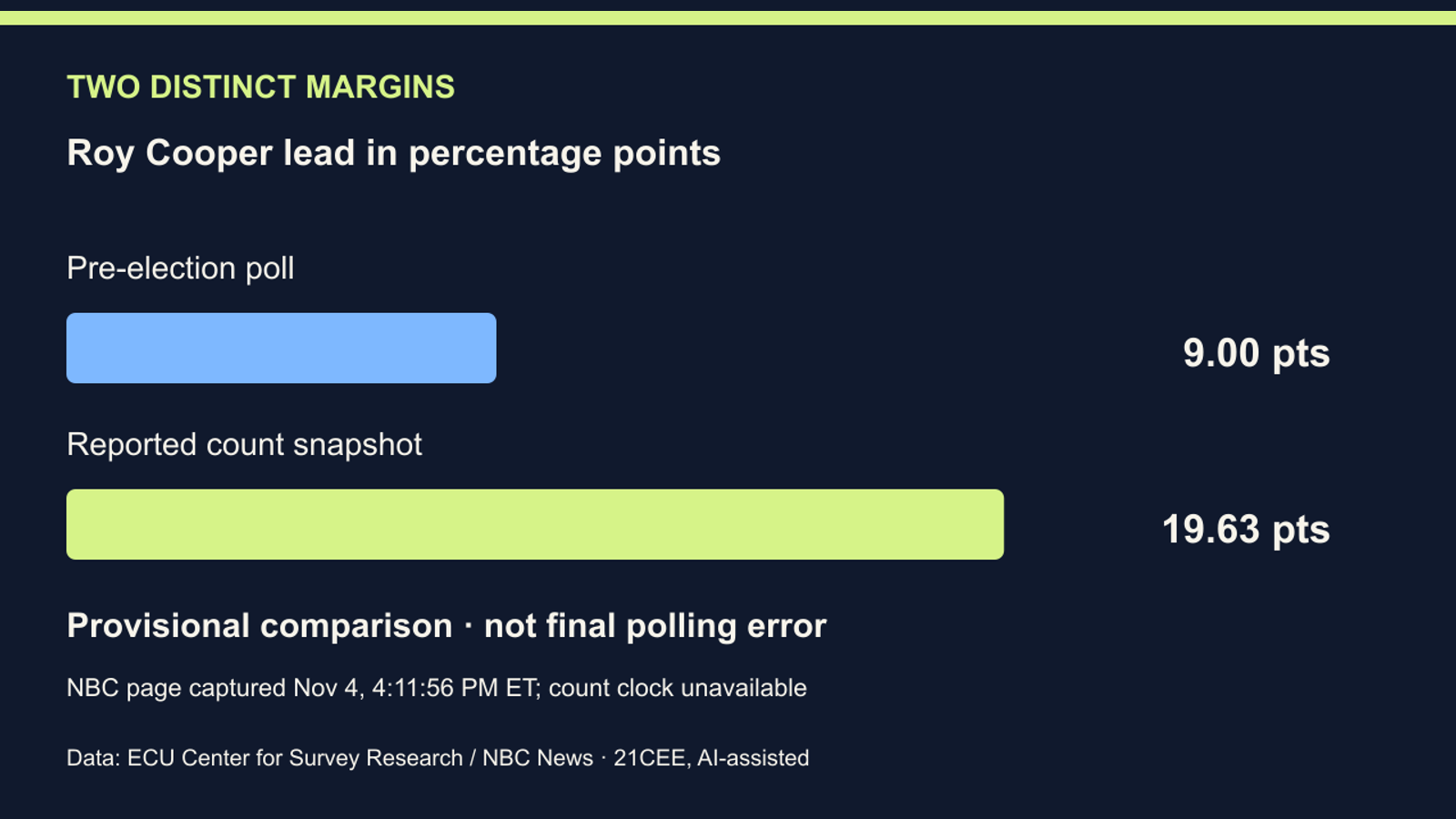
| Candidate or ticket | Votes | Reported share |
|---|---|---|
| Roy Cooper | 2,467,963 | 58.72% |
| Michael Whatley | 1,643,088 | 39.09% |
| Shannon Bray | 55,726 | 1.33% |
| Michael Dublin | 36,404 | 0.87% |
| Total | 4,203,181 | 100.00% |
Original sources and method
- Original pre-election poll tables · ECU Center for Survey Research
- NBC News projected-winner race page · NBC News
Poll margin = first candidate’s published percentage minus second candidate’s. Provisional count margin = 100 × (first candidate’s votes − second candidate’s votes) ÷ all reported votes. A winner projection and a certified count are distinct. Counts remain unofficial; this story does not treat either the retrieval clock or the network’s projection as a final tally.