Kansas: the poll had Hamilton ahead, and the count does too
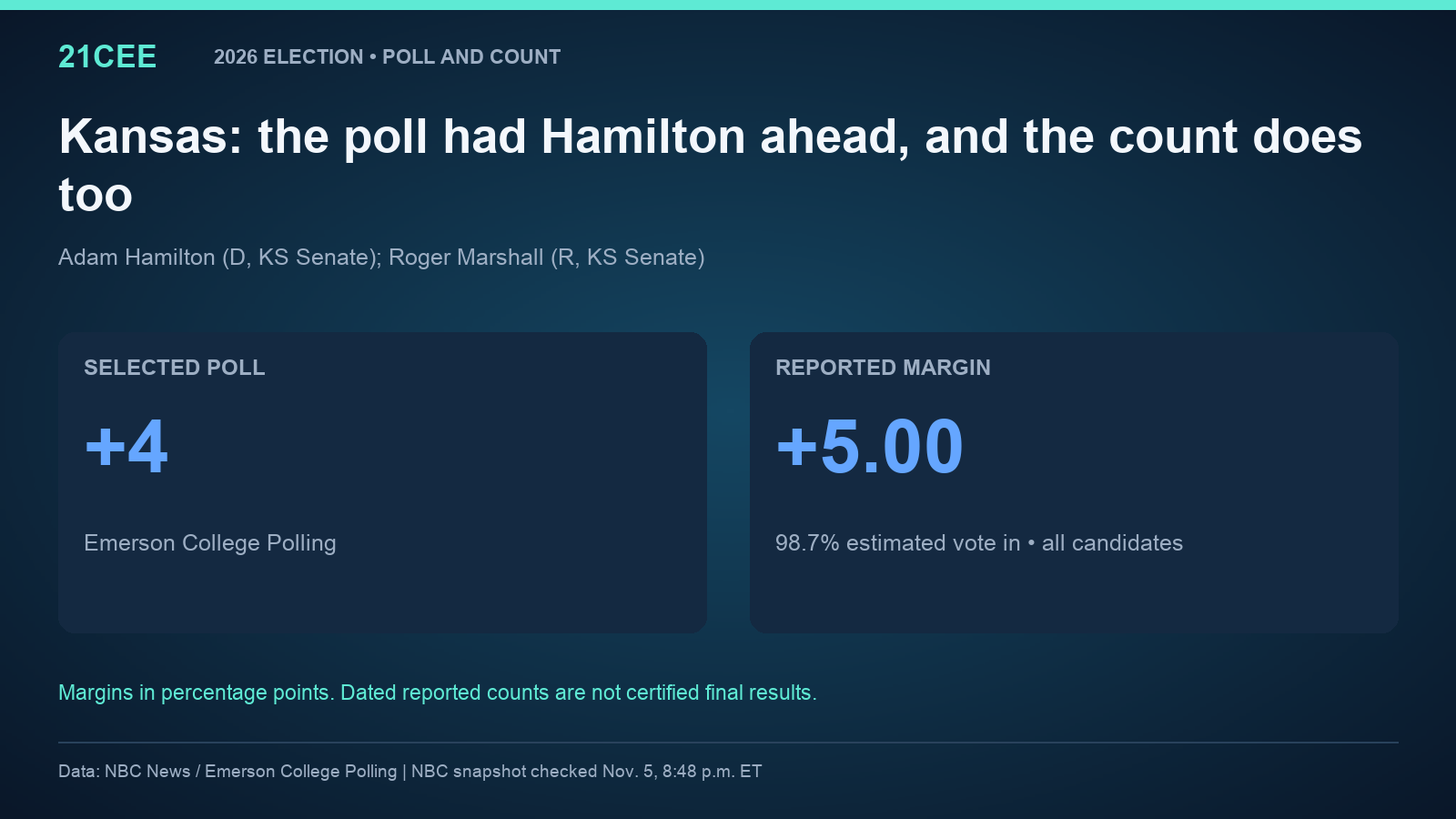
Emerson College Polling put Hamilton 4 points ahead. NBC’s November 5 evening snapshot has a 5.00-point lead, with 98.7% estimated vote in.
What the count shows
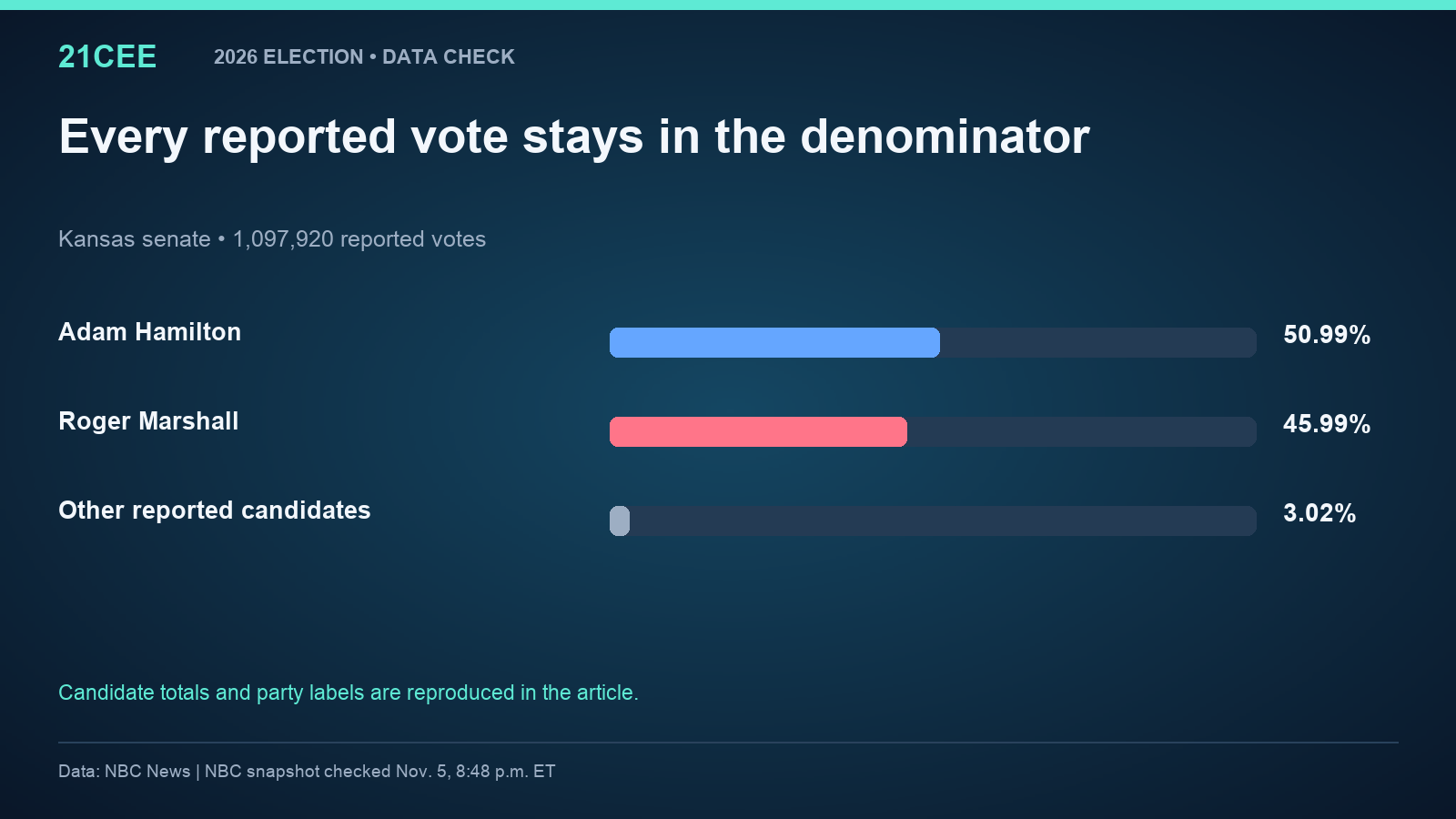
Adam Hamilton (D, KS Senate); Roger Marshall (R, KS Senate). NBC News projects Adam Hamilton as the winner. In the snapshot checked November 5 at 8:48 p.m. Eastern, Hamilton had 559,853 votes to 504,950 for Roger Marshall. The reported lead was 54,903 votes, or 5.00 percentage points across all candidates.
The selected Emerson College Polling poll had a 4-point Hamilton lead. The reported margin is 1.00 points larger than that published poll margin. The projected winner matches the poll’s leading candidate; the size of the lead is a separate test.
| Candidate | Source party label | Votes | Share of all votes |
|---|---|---|---|
| Adam Hamilton | Dem | 559,853 | 50.9921% |
| Roger Marshall | Rep | 504,950 | 45.9915% |
| David Graham | Lib | 33,117 | 3.0163% |
| Total | 1,097,920 | 100% |
| Measure | Margin in percentage points |
|---|---|
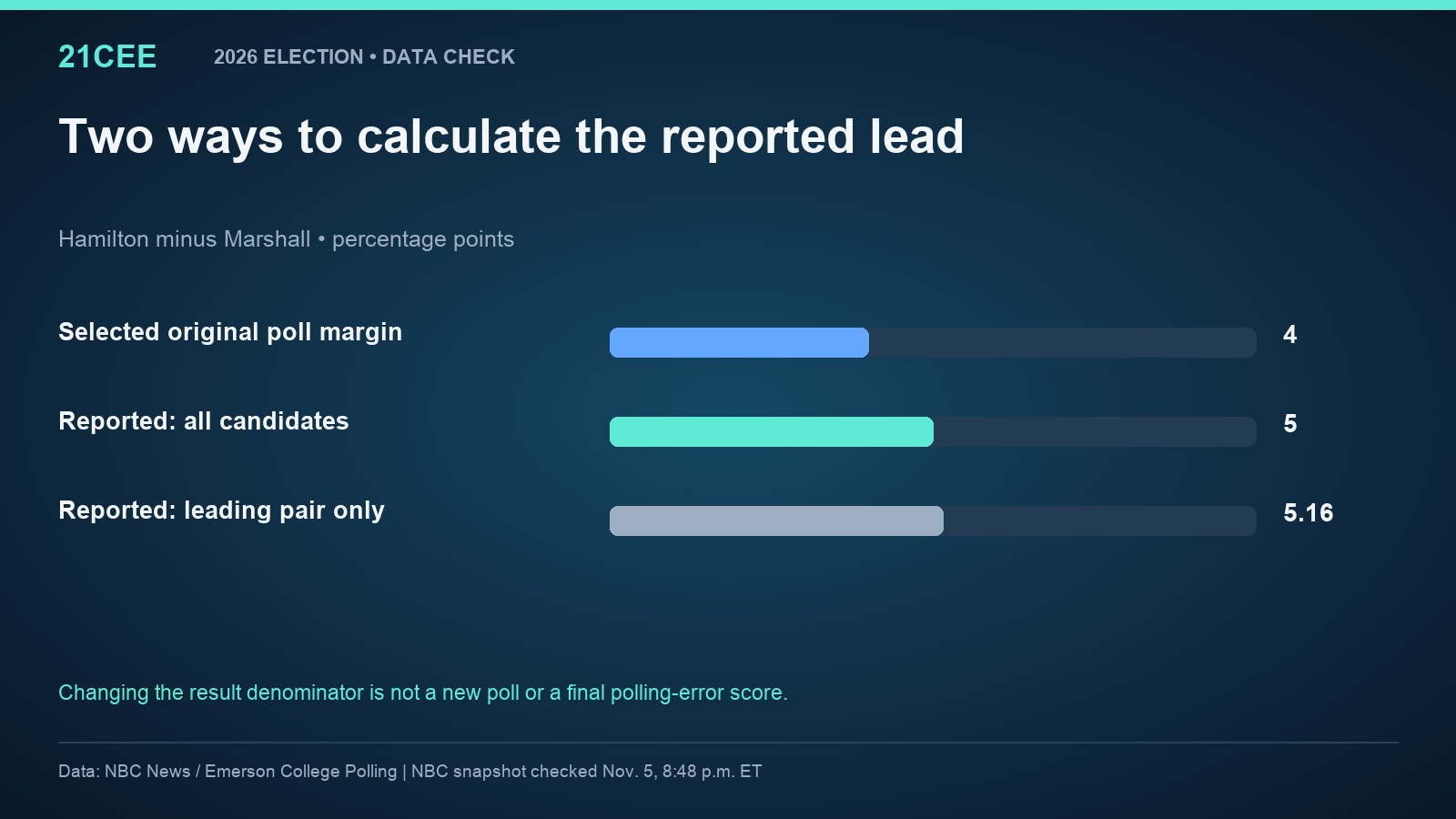
| Selected original poll | 4 |
| All reported candidates | 5.000638 |
| Leading two candidates only | 5.156165 |
What makes this comparison useful
Emerson’s initial Kansas question had Hamilton at 49% and Marshall at 45%. A follow-up allocating undecided leaners produced 50% to 47%. Those are two stages of one survey. This article keeps the initial four-point lead as its main baseline and shows the three-point follow-up separately.
Keep the original poll intact
Emerson surveyed 800 likely Kansas voters October 26–28. The release describes voter-file text invitations, landline automated interviews and an online panel, and reports a ±3.5-point credibility interval. The initial ballot and undecided-leaner follow-up remain separate.
The selected survey’s original ballot and methods are reproduced below. It is one published poll, not a polling average or a claim that no later poll existed. Undecided responses, minor candidates, the voter screen and the field dates remain part of the record.
The survey’s stated uncertainty applies to its estimates under its method. It is not an automatic pass-or-fail cutoff for a difference between two candidates, and it cannot turn a provisional count into a final polling-error score.
| Candidate or response | Published percent |
|---|---|
| Adam Hamilton | 49 |
| Roger Marshall | 45 |
| David Graham | 3 |
| Undecided | 3 |
| Stage | Adam Hamilton | Roger Marshall | Lead, points |
|---|---|---|---|
| Initial ballot | 49 | 45 | 4 |
| With undecided leaners | 50 | 47 | 3 |
The denominator check
Using all 1,097,920 reported candidate votes produces the 5.00-point lead. Restricting the denominator to Adam Hamilton and Roger Marshall produces 5.16 points. Both calculations are shown so readers can see the effect rather than confuse the two measures.
For a fully two-candidate poll comparison, the published poll shares must also be renormalized. It would be misleading to change only the result denominator and describe that as a like-for-like final error.
Where the evidence stops
NBC estimated 98.7% of the vote in. This is a dated reported-count snapshot, not a certified final result. The national senate payload was updated Fri, 06 Nov 2026 01:48:30 GMT. That is the source update clock, not the original race-call time or a timestamp for an individual ballot batch.
A final polling audit should repeat the same calculations after the outcome is stable, preserving the original pre-election poll. This article does not change 21CEE’s locked forecast or claim that a polling gap proves which voters switched parties or stayed home.
Sources and calculations
Reporting: the linked original publishers. Calculations and graphics: 21CEE. Poll shares are kept as published; result margins use the exact candidate counts in the accessible table. The source clocks above describe the retained snapshot. No certification or original call time is inferred.